Showing posts with label IndianCulture. Show all posts

Monday, February 23, 2015

Culture - Fragile, handle with care

It is shocking to realize that I have all along been totally oblivious of what is happening around me. Worse still, I have been living in a fool's paradise assuming things to be exactly the opposite of how they really are. It is such a shameful thing that I have been so ignorant about what is happening with such an important thing as my own culture.

That is the problem with taking things for granted. You see, when I was young, my culture was assumed to be so strong. It had lasted a few millenniums and emerged relatively unscathed from long years of colonial rule. True, we had changed the way we dress and had taken to considering speaking in English as somehow more sophisticated than speaking in our own lingo, but those were but cosmetic changes compared to how little had been affected in all the rest.

I stop paying attention to it, assuming that what had been strong enough to last all the cataclysms of the ages would be strong enough for my lifetime, and find that suddenly it has become so weak, so fragile that it gets threatened by some ill-informed book, some pieces of art, the depictions of some fictional characters and even, horror of horrors, cartoons! How incredibly naive I was, how uncaring of my roots that I thought that, even if they did defame my culture, they could hardly make a dent on the strength of my ethos, and the best thing to do was to laugh them away. AND, in case there was any truth in the negatives stated, my culture had the resilience to change and become stronger - as it has in the past, when it stopped animal sacrifices and sati.

This convenient assumption - that, if the portrayal is wrong, it is ridiculous to give it any importance and, if it is right, it is ridiculous to muzzle it - is, I now realize, quite likely to bring on the end of my culture. It has now become so fragile that even the mild breeze, that these things are likely to be, is enough to blow it away and needs safeguarding with utmost vigilance.

I need to make up for my past lapses. How then do I ensure that I work in such a manner as to strengthen my culture? Do I take up the cudgels against the people who urinate all around my temples and scratch immortal love stories like "Rocky luvs Pinky" on centuries old sculptures? Nope - no-one considers that as threatening to our culture. Do I work towards the cause of rejuvenating Classical Music and dance? I do not think so. I have heard bhajans set to the tune of 'Ek, do, teen....' (And, who knows, "Chikni Chameli.." or whatever, now), so it looks like giving up Indian classical music/dance is not a big deal.

Do I proselytize about the strong family system here - that the intrusiveness may be a by-product but the support in times of need is reliable? Yeah Right - just as everyone and his uncle is ensuring that about the only thing that remains of the family system is the intrusiveness. Do I speak of the 'Athithi satkar' and the need to sustain the openhearted and open-minded way in which we treat guests and accept their different way of life? But that, too, is not necessary to strengthen our culture. What is important is to make the other guys accept ours. Just as the more important thing to strengthen my culture is for me to ensure that the women in my vicinity are completely covered, and the not too important and, maybe, even irrelevant thing is to avoid molesting women myself.

Do I propagate the Indian philosophical thought of a life of detachment from the material world? Nonsense - not when a sizable proportion of even the spiritual gurus are queuing up for their BMWs. Do I try to spread the idea of "God is in Everyone"? Don't be ridiculous - we all know that he cannot be in those guys praying to a different God OR these women who dress in a manner quite against our culture (There is this problem for me. With this sprawling country with so many different dress codes, exactly WHAT fits our culture and what does not?) Anyway, all this thing about 'Advaita' is a relatively modern construct and, if we had been around in those days, we would have eliminated all such threats to our culture right then.

I am all atwitter to do something to safeguard my culture but, unfortunately, cannot think of anything right away. And, meanwhile, my inaction is probably causing my culture to be blown away by these vagrant breezes.

Wait! Where is my cudgel? I can go around bashing young couples in my neighborhood on Valentine's day.

Oh! Shucks! Valentine's day is already gone. I will have to wait for a year before I can do something to safeguard my culture.

I sure hope and pray that it can survive till then!

Saturday, November 15, 2014

The Upper Mustang Trek - VII (The Legend of Tulsi)


Click to read Part 1Part IIPart IIIPart IVPart V or Part VI

All through the trek, we have been traveling in the vicinity of the Kali Gandhaki river and, now, we are about to go to Muktinath. It is necessary, then, to also tell you about the myth behind the river, since it is an inseparable part of the myth of Tulsi - the plant that Hindus venerate. There are two versions of the tale - one from the Shiv Puran and one from the Devi Bhagavatam.

The Shiv Puran version is the tale of Jalandhar and Vrinda. Once, when Lord Shiva was angry with Indra, due to the latter's ego, he opened his third eye and was stopped from immolating Indra by the prayers of Brihaspathi and the penitence of Indra. His fury, however, lodged in the Ocean and Jalandhar was born. Thus, in a manner, Jalandhar was the brother of Lakshmi, who also arose from the Ocean at the time of the Samudra Manthan (The churning of the Ocean).

Jalandhar married Vrinda, the daughter of the asura Kalanemi. Vrinda was an ardent devotee of Lord Vishnu (one version is that she was a gopi cursed by Radha) and as long as she was chaste and prayed for Jalandhar's welfare, Jalandhar was protected from any harm. Jalandhar proceeded to conquer the three worlds and the devas were deprived of their kingdom. Lord Vishnu fights a long and indecisive battle against him but, on the entreaties of Lakshmi, he makes peace with her brother.

Hearing the Sage Narada extol the praises of the beauty of Goddess Parvati, Jalandhar sends a message to Shiva to live true to his reputation of a Yogi and surrender his beautiful wife. Angered by the missive, Lord Shiva battles against Jalandhar but is unable to overcome him. Meanwhile, Jalandhar creates an illusion that keeps Lord Shiva and his army occupied and goes to Goddess Parvati in the guise of Lord Shiva. The Goddess recognizes him for who he was and rises in fury to kill him whereupon he escapes.

When the Goddess asks the Lord Vishnu about why Lord Shiva was finding it difficult to vanquish Jalandhar, he tells her that the Vrinda's chastity and devotion to himself was protecting Jalandhar. The Goddess, then, requests him to put an end to Vrinda's chastity if that was the only way to vanquish Jalandhar.

Heavyhearted at practising such a deception on his devotee, Lord Vishnu takes the appearance of Jalandhar and goes to Vrinda, who receive him as a wife would receive her husband. With her chastity destroyed, Lord Shiva kills Jalandhar with his Trishul. Learning of the deception, Vrinda curses Lord Vishnu to be trapped in a stone (which is the reason why the Shaligram is supposed to embody Vishnu) and, also, that he would suffer separation from his wife (as he did in the Ramayan). Thereafer, Vrinda immolates herself but Lord Vishnu saves her hair and converts it into the Tulsi plant.

The Devi Bhagavatam has a similar tale - with minor variations. In an argument between the Goddesses Lakshmi, Ganga and Saraswati, Ganga and Saraswati are cursed to become rivers and Lakshmi is cursed to be born human and marry an asura. An aspect of Lakshmi is born as Tulsi, the daughter of Dharmadwaj. She undergoes austerities to marry Lord Vishnu when Lord Brahma appears and tells her that before marrying the Lord, she would have to marry an asura.

Meanwhile, Sudama (who, in this case, is considered an aspect of Lord Vishnu) is born as an asura - Shankachud, son of Dhamba - and he marries Tulsi. Shankachud is blessed to be invincible as long as Tulsi remains chaste. He conquers the three worlds and, in his arrogance, challenges the Lord Shiva. The Lord Shiva finds it impossible to vanquish him.

Lord Vishnu then, reluctantly, takes the shape of Shankachud and goes to Tulsi. Shankachud is killed by Lord Shiva and the news is conveyed to Tulsi while Lord Vishnu is with her in her husband's apearance. Upon being accused by an inconsolably weeping Tulsi, Lord Vishnu appears in his true shape. Tulsi accuses him of being stonehearted and curses him to become a stone. Her body decays into a river - Kali Gandhaki - and her hair turns into the Tulsi shrub.

We have a habit of picking all the wrong lessons to learn from our myths. The things to be noted are that a. Even though it WAS the Lord, who committed the 'crime', and even though it was done under compulsion, he accepted the punishment imposed on him and b. Far from being reviled as unchaste - as would probably have been done in these unjust times - Tulsi is a deity to be venerated by the chaste.

Now that we know why the Lord Vishnu - in the form of the Shaligrams - lies always in the embrace of the Kali Gandhaki river, and why Tulsi is Vishnupriya, we can proceed with the last stages of the trek.

Photo Credit: Sampat


Tuesday, August 27, 2013

Heritage under threat

A temple thirteen centuries old; Inscriptions on stone portraying a history of centuries; deities that have been sung about in the ancient - and still living - literature of the language and being worshiped even today and a temple situated in the capital of the state. What is the image that strikes your mind of a renovation of such a temple by an organization purportedly in charge of maintaining temples? Experts handling the process with a delicate care to ensure that the temple retains its original look of antiquity or construction workers uprooting sculptures and destroying inscriptions in a bid to tile the interiors?

If you thought that it would be the former - then you are sorely mistaken in your India. At least, Tamil Nadu where the Tiruvottiyur temple situated in Chennai is being renovated - with all the insouciance of renovating a slum. This album of photos here, shared by a friend, will show the extreme care and attention lavished on these priceless relics of our history.

The Hindu Religious and Charitable Endowments (HR and CE) Department, which is in charge of temples, does not, purportedly, even have the authority to disturb the sanctum sanctorum but has given scant regard to the limits of its authority as per News reports. As for the expertise they bring to the table, scores of temples across Tamil Nadu bear sufficient witness as per this report in The Hindu.

http://www.thehindu.com/features/friday-review/history-and-culture/targets-of-destruction/article2109633.ece

The specific instance of this temple in Chennai has also been covered by a Tamil newspaper here. Whether any of this will have even a minimal impact on the activities remains to be seen but remaining silent was no longer an option for me.

Yes, this country has a variety of current problems and, to many, they may seem more important than this. For me, however, no person can be grounded in his self unless he has a respect for where he comes from. If the foundations of that respect will be destroyed and we start disrespecting ourselves as a people - as we show by disrespecting our history, there can be no salvation for us as a Nation.

Tuesday, February 19, 2013

Indian Sculpture: The Samavediswarar Temple


When one talks of Indian Sculpture – and South Indian Sculpture in particular – the top tourist destination that springs into the mind is, probably, the Pallava sculptures at Mahabalipuram and, secondarily, the Kailashanatha temple at Kanchi. One may then cast an eye at the Chalukyan Sculptures in Aihole/Pattadakal/Badami or the Hoysala sculptures at Belur-Halebidu in Karnataka. Hampi of the Nayakas may also attract attention.
Yet South India is rich in innumerable temples dotting the landscape with a veritable treasure trove of sculptures waiting to be explored. It is, probably, this plenitude that seems to make the local populace totally indifferent to the artistic richness that lies amidst them. This indifference has, in turn, contributed to neglect and, thus, not only do these various temples housing sculptural marvels remain obscure but the sculptures also tend to be ruined by neglect.
In fact, the sculptural heritage of the Cholas and Pandyas is almost totally ignored – the major Chola and Pandya temples being visited mainly as grand temples or places of pilgrimage rather than for their sculptural heritage. Talk of the Cholas and the only thing of artistic merit that springs to the mind are the Chola bronzes. Yet, it is in their times that exquisite sculpting in miniature panels arguably reached their zenith. The panels of the latter age – the Hoysalas and Nayaks – do have lovely detail but they are normally larger and, thus, arguably do not give the same impression of intricacy that the Chola panels portray.
During my visit to Srirangam to explore the sculptural heritage of South India, I had the opportunity to visit a small temple – The Samavedishwarar temple in Tirumangalam near Lalgudi. This temple set in serene surroundings is an exemplar of the early Chola (8th to 10th Century AD) temple.
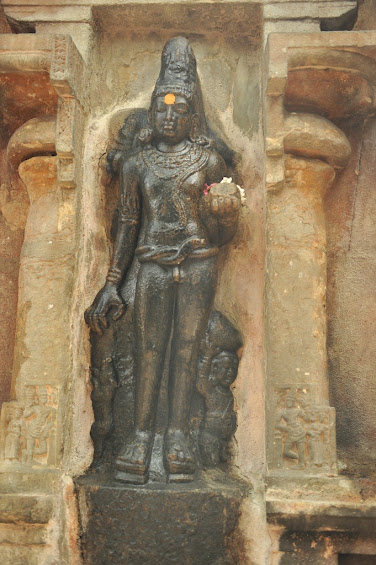
Take a look at the sculpture of the ‘Bikshadana’ in one of the niches.
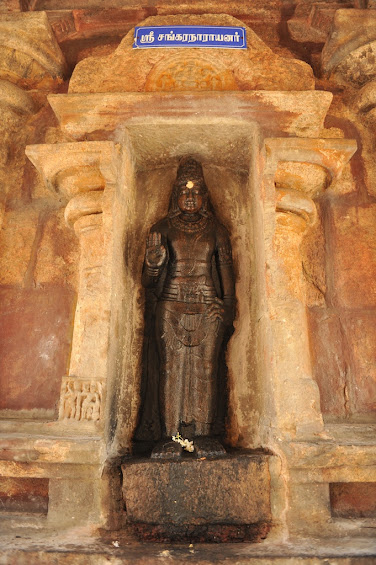
 This is a portrayal of the Sankaranarayana in another niche.
 
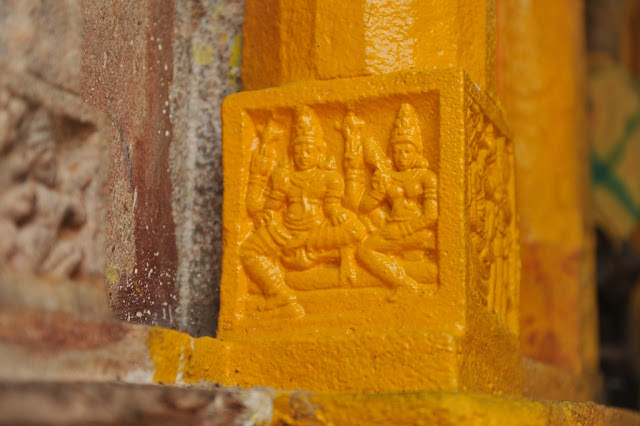
Vishnu and Lakshmi in one of the pillar panels.
 
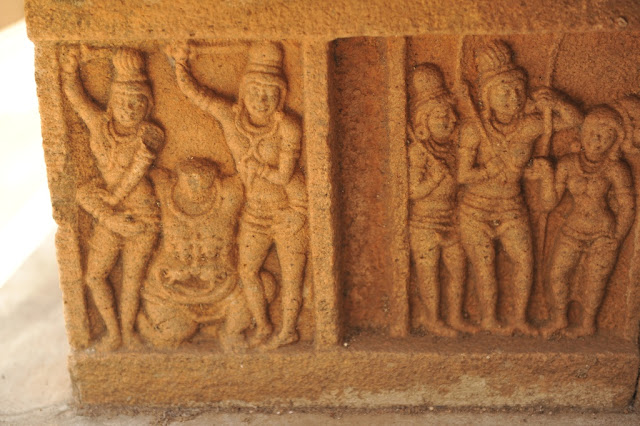
There was this lovely Ramayana series of miniature panels. You can see the Kabanda episode from the Ramayana in the miniature below. This was just above the basement and the sculptor does not seem to be afflicted by the so-called ‘chalta hai’ attitude considering his attention to detail in this miniature which is not in the most noticeable of positions.
 
That visit to the temple was one of the most rewarding experiences for me in this trip. You can get a virtual tour of the trip in the photographs of Arvind Venkataraman here, whose photographs have been used by me in this post as well.

More information of cultural interest may be seen here