Showing posts with label Travel. Show all posts

Thursday, January 23, 2014

Birders again - Chilika Lake

I know you people have lost hope of being free of the bird-brain but you must have thought that you had, at least, finished with the Birders. Not really! There is more to come but, thank my kind heart, no more than this one. At least for now.

The trip to Sunderbans was followed up with a trip to Chilika Lake, some 100 odd kilometers off Bhubaneswar in Orissa. Since this is considered the largest wintering ground for migratory birds in India, it was a vain hope to avoid Birders - and, of course, birds. Not that the birds were any problem to me, in and of themselves. The problem only was that people kept asking me things like, "Did you see that bronze-skin Jacana?" and I go "Ho! Hum!" - looking 45 degrees away from where it was - only to hear a derisive laugh and the words, "That's a little egret, you idiot!" Times like that, I wished heartily that Nature had not been so creative and had stuck to making only one type of bird.

Anyway - there we were on a boat, propelled by a pole on the marshy lake with birds galore around us. Marsh Sandpipers, Black-winged stilts, egrets and herons - they were all over the place. After those days at Sunderbans of peering hopefully at the shore in the hope of finding a lone Kingfisher and jumping with joy when a distant bird deigned to make an appearance, this was boring. I mean, when there are so many birds around you, where is the excitement in sighting one?

As usual, I was wrong. When you have a plethora of birds, you apparently started looking for the ones that were not so ubiquitous and felt excited about it. So, you start looking at distant dots and scream,"There is a Brahmini duck" OR "There is an open-billed stork" and go into raptures. Soon I was into the full swing of things, clapping the guide's binoculars to my eyes and going gaga over rara avis - while concealing the fact that I could only manage to swing the binocs between the sky and the water and could sight nary a bird with it.

This was the evening of the first day. Apparently far more birds frequented the place in the morning. I went to bed with visions of shooing off the pesky pond herons and jacanas, which were too mundane to be noticed, in order to view the Grey heron and other such relatively rarer birds.

The next morning, when we went to the lake, we found that there had been a communication gap. Birds were supposed to flock the lake then but, apparently, no-one had thought to tell the birds. We found only as many birds as on the evening before. Maybe the birds thought it was a pity to have traveled so far and not take a look at the dolphins and had gone over on a sight-seeing trip.

The trip had its moments as usual. There were a couple of egrets engaged in either a mating dance or a fight (And people assure me that the two are different in humans as well as in birds. It is all hearsay evidence for me). One bird kept jumping close to the other only to have the other fly off to a different location every time. There was that Casanova of a buffalo with both a drongo and a little egret perched on its back while the others had to do with only one or none. (Did I forget to say? The locals apparently grazed their buffaloes in the lake). There were those couple of drongos ecstatically putting on a virtuoso aerial display - maybe a mating dance again or maybe they were just show-offs playing to the gallery.

We rounded off the trip with a visit to the Lingaraju tempe in Bhubaneswar - a marvelous example of Kalingan architecture. Needless to say, I prayed to be saved from the fate worse than death - of becoming a Birder!

Monday, January 20, 2014

Bird-brain among Birders

A trip to Sunderbans only evoked a pleasant feeling of going out into wilderness and, maybe, manage to see a few wild animals while I was at it. Little did I realize that my first sighting of a new species would happen at the Howrah Railway Station. I had heard that such beings existed but it was, nevertheless, a fact that I was shocked and surprised by the fact that Birders were not mythical beings. Worse still was the discovery that the harmless beings, that I had hitherto trekked with, also morphed into these awesome (or is it awful?) beings when I met them at Howrah.

For a person who could not see any difference between a sandpiper and a sand plover, this was a huge shock. (Confession: The only sandpiper I had known till this trip came in a bottle). I can still hark back to my first lesson on birds - that the black one was a crow and the brown one a sparrow. I capped off my learning about birds and was proud to have mastered the theory on the day I realized that the hen, which is still not convinced that wings can be used for flying, and the eagle, which soars so high always that it seems unconvinced that the legs are of any use at all for locomotion, are both birds. That my pinnacle of achievement did not even mount to a respectable amount of bull excreta was driven into me in the course of this trip.

Three days spent in a launch (I skip the nights at the resort - drunken revelry is not a fit subject for this blog) surrounded by bazooka sized cameras, machine-gun like binoculars and frenzied cries off "There! There! Look at that ibis" and the like! In the intervals when the launch took to the middle of the waters and no sightings were possible, the conversation revolved between the Greek of photography esoterica and the Latin of rare birds like the Great Indian Bustard. Having no experience of looking wise and interspersing apparently knowledgeable questions that concealed the absolute vacuum inside, I was reduced to gawking and looking the perfect imbecile (NOT looking my natural self, thank you!).

Matters were compounded for me when I discovered another of my uncanny abilities. When people were excitedly looking at that collared Kingfisher, I discovered that I had this knack of looking everywhere else except where it was. When they helpfully handed me the binoculars and said, "Look 2 O'Clock", I had to curb my urge for lifting my wrist for a look at my watch and compute what direction it meant. By the time I had done these trigonometric computations, the launch would have moved on, the bird would stay put and I would have to rework it all for 3 O'Clock. The net result was a Suresh spinning like a top (well - only 180 degrees, since even I had not gone so far as to look at the other bank of the river for a bird on this bank) on the deck of the launch with the birds looking on with grave interest, rather than the other way around.

Did I forget to mention? The Sunderbans is a lot of islands at which you can look on but not step on. So, you traveled in boats and tried to sight animals and birds that could be seen - if they deigned to come - on the banks of the river. This river too, incidentally, was one of the confused lot - it had not made up its mind whether it was a river or the backwaters since the water was brackish. The clayey soil ensured that trees had to adopt the ingenious means of poking their roots out into the air to breath - the so-called breathing roots. THAT was the only satisfactory part for me. Thankfully trees are large enough to be more easily located and also stayed put in one place so that I could take hours to locate them and still expect to find them.

Despite my super-abilities, I did manage to sight three crocodiles sun-bathing (I know - not the most brilliant feat of observation), a couple of monitor lizards and one jungle cat that swished a disdainful tail at me as it vanished into the woods. There was one monitor lizard that had blended so well into the trunk of the tree it was resting on that it was nearly impossible to locate. I did manage to sight it (AT LAST!) - a feat of which I was inordinately proud.

Some sights that will linger in my mind - a tree so hung with parakeets that it seemed to have more birds than leaves; a sandpiper taking a floating crocodile for a log and trying to alight on it only to recognize what it was at the last moment and hurriedly flying away; and, above all, the serene waters and lush green woods that were a balm to the eyes and the soul.

The wild has always exercised a fascination for me - and my own joy comes merely from soaking in the ambiance. I must, however, admit that this frenzy to locate the next bird found lodgings in me too and I was running around the boat and peering (in exactly the opposite direction most of the time) to sight the common kingfisher (something I disdain to notice even when it dances a saraband in front of me in Bangalore) and being sorely disappointed when I failed. The infection is wearing off now - but, who knows, I may yet morph into one of those mythical beings - Birders. Then, indeed, would you see a bird-brained Birder!

P.S: I am no photography buff and, so, no photographs till I get some from one of my companions on the trip.

PPS: About the only good news on my return from the trip is the fact that Blogadda seems to have shortlisted my blog for its awards in the Humor category. (Surprising, I know but these things do happen sometimes)

http://win.blogadda.com/view-blogs-voting/humor_satire/Life_is_Like_This/

Friday, September 21, 2012

A Trip to Munnar

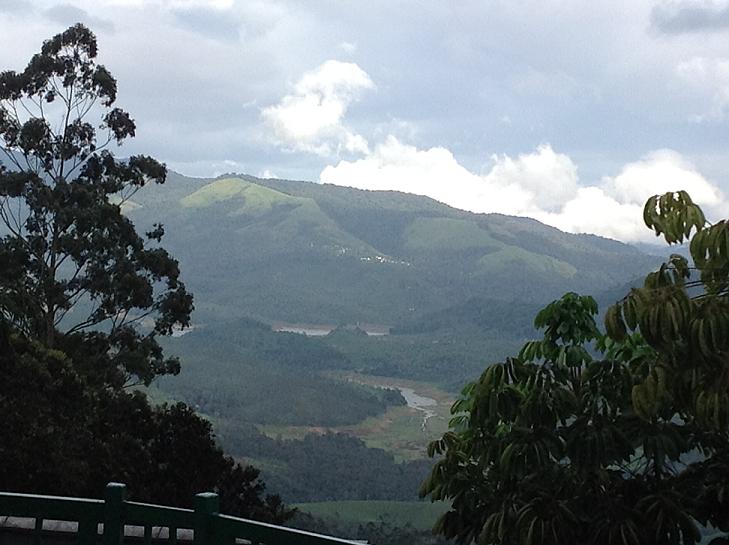
Lounging lazily on the verandah in front of our wooden cottage at Club Mahindra and gazing out at the view in front of me, I could not help thinking that it was worth the tiresome and, for me, fearsome journey from Bangalore to Munnar. Fearsome merely because it involved a 130 odd kilometers drive from Cochin to Munnar. My stomach tends to be considerate of the cars I ride in and tries to lighten the load on the car by emptying itself through the mouth. Luckily no such mishap happened – though R.Suresh, Venky and Meera may violently disagree about the luck, because it meant that they had to listen to me singing non-stop!
 The play of mist and sunlight on the valley and the distant hill was endlessly engrossing. It had been raining in Munnar and how lovely greenery looks when it is glistening with moisture! The drive towards Club Mahindra had its entrancing sights too – with waterfalls and the orderly verdant beauty of tea plantations – and the destination lived up to the promise of the route. R.Suresh and Venky were almost coerced into clicking pictures every other second since every change in the light and mist play highlighted a new facet of the view (All pics in this post by R.Suresh on his IPad).
One of the things that I relish in any stay at Club Mahindra is the sumptuous spread – particularly for breakfast. I have never been known to be a frugal eater but, when I am here, I tend to outdo myself and that is saying quite a lot. An over-full stomach and a road trip do not normally go together – and it was one of those normal times when we went to view the Gudampara valley.
The road for the most part was quite good. Then, we shifted to a jeep to go inside the forest towards the view point. Of all the tracks that I have traveled this one easily takes the cake for being the most bone-rattling trip ever. For about five kilometers, we felt like clothing probably does inside a washing machine.
The view at the end of it all was well worth the trip. The plains of Tamil Nadu were laid out like a miniature model in front of us and even distant towns could be seen. The guide said that, beyond a point at the view-point, it was Tamil Nadu territory – and, as if on cue, our mobiles chimed with SMSes welcoming us to Tamil Nadu!! We had barely spend about 10 minutes there when a sudden downpour caught us out in the open and we were drenched before we could race back to the jeep.
It is one of my idiosyncrasies that I constantly overestimate my own physical prowess. We indulged in river-crossing – which meant that we dangled upside down, harnessed to a pulley that ran on a steel cable across a piddly little stream and were expected to pull ourselves to the other side by the strength of our arms. Looked easy enough when R.Suresh did it first but, God, came the time for me to pull myself over it was pure hell. After hitting the middle and with my overweight body pulling the cable down so far that the angle of ascent seemed about 30 degrees, I was totally exhausted by the time my head hit the platform on the other side. When the chap asked me if he could pull me over I assented eagerly – mentally kicking myself all the while for not having thought of asking him to do so at mid-point!
Meera opened my eyes to a new world of plants. Hitherto, all I had seen was that they were mainly green and of various shapes and the little bits of color that dotted the landscape were flowers. Being a serious plant-lover and grower, she had insisted on a visit to a nursery. That is a visit that will live on in my memory. How endlessly inventive and beautiful Nature is in the shapes, sizes and colors of leaves and flowers! Being enraptured by a view is nothing new to me but getting engrossed in the minute details of the components of a view was an enthralling experience. (By the way, Meera bought about a dozen plants and was agonizing for the rest of her stay there about whether she would be allowed to take them back home on the flight. In case any of you are wondering about the same, they do allow you!)
By the time the visit ended, it seemed such a pity that it ended so soon. Well! There is always a next time!

Tuesday, September 11, 2012

Wandering in Melbourne


Shopping and restaurants! The former has held no appeal for me and the latter fills my mind with dread. Ah! The spirit is willing but the flesh is weak. The moment I try anything that I have not tried before, my digestive system rebels! No matter what the plumbing accessories manufacturers say, it is difficult for me to think time well-spent if all I see is a wash-basin – appropriately adorned with what used to be in my stomach – on a trip to a new place. Nor do I think I would be a welcome companion if my stomach acts like a high-yield gas well with outlets at both ends. Thankfully, Melbourne is supposed to have a restaurant for every palate and, thus, I can relax and look forward to actually seeing other things than my bathroom fittings.
A veritable feast of art, culture and architecture awaits the visitor to Melbourne. The Melbourne Museum, the Johnston collection, the National Gallery of Victoria and the Australian centre of contemporary art are just a few of them. One can imagine an art and culture lover to lose himself in the creative expressions on display. It is a shade more difficult for me to imagine myself as that art and culture lover! With practically no eye for visual creativity, all that I get when I visit museums is a crick in the neck. Then, when I see someone else’s photographs and descriptions of the same place, I go, “Ah! You mean it is that same place I visited?” It is thus that, whenever, I visit museums I feel like I am preparing for an examination – from someone or the other who is bound to ask me, “You went there and did not see THAT?” in contemptuous tones.
If I give the impression that the moment someone tells me, “It is your time to visit Melbourne, NOW”, I make a list of all the things that I cannot or will not do in Melbourne, I really cannot blame you. The idea, however, was to get that out of the way before I get to talk of all the things that I would do there.
One of the most attractive options for me is that Hot Air Balloon ride at dawn. I have always loved watching a city from above while landing at a destination and, from a  Hot Air Balloon, I can take it all in more leisurely and with a wider angle of vision than is provided by those oh-so-small aircraft windows. Not to mention the novelty of the ride, itself, as well as the vision of a dawn sky. (What do you mean that I am so full of hot air that the balloon ride is superfluous? I don’t get that at all!). Of course, having seen the city in its entirety from the sky, I can dispense with city tourism and get down to what I like doing best!
Cruises! God! There are so many mouth-watering prospects for cruises in the place. I am particularly taken by the River Gardens cruise that promises you picturesque gardens and parklands. What can be better than floating on water and feasting your eyes on picturesque greenery? The South Island fort cruise is another enthralling prospect promising stunning seascapes, a trek and delving into underground passages. Mmm! A delicious prospect! Further away, there is the option of the Yarra River cruise.
The mention of Australia instantly evokes memories of fantastic beaches. What a plethora of beaches there are to explore in Melbourne – each with its own unique beauty and offerings. The spectacular sunsets of St. Kilda beach, the sensational Melbourne skyline from Brighton Beach, kite-surfing and beach volleyball at Middle park – the options seem endless! Not to mention the possibility of trying my hand at snorkeling and wind-surfing. The fact that my only idea of swimming is going straight down would be a great help in snorkeling but for the fact that I do want to come up alive as well. Anyway, one has to see what can be done when a man is unable to imitate a fish – except in the stink! (What was that? My only idea of beach-views is what I derived from watching Pamela Anderson in Baywatch?? I will have you know that I was watching the beaches in Baywatch – not that I claim to have studiously averted my eyes when Pam swam into my vision!)
If that were not a surfeit of options, there is parasailing, rock-climbing, abseiling and sky-diving too. Ah! Well! Even if I am refused the option to take up deep sea diving because I do not know swimming, I cannot be refused the option to sky dive because I do not know flying!! The only limit on what I can do is what my thin wallet will allow me to do.
The prospects at Melbourne seem so endless that the only fear is that I shall spend the stay there in the dread of hearing the words, ‘It is your time to leave Melbourne, NOW!’

Monday, June 25, 2012

River-Rafting – Shivpuri to Rishikesh


I have little imagination when it comes to danger so it is relatively easy for me to contemplate doing things that could lead to injury. When it comes to discomfort, however, I am right up there with the brightest. Comes the time to think of motion sickness I am so far ahead of the crowd that creative geniuses cannot even see my dust!
Consider the fact that the original idea of motion sickness was closely allied to water – sea-sickness! Consider the fact that river-rafting was not expected to be done in tranquil waters and that motion sickness is more violent when the journey is not smooth! Consider the fact that it was just a day and a half since I had closely resembled a water faucet from both ends of the alimentary canal! Consider further that there was a half-an-hour trip by road to Shivpuri before we could even start on the river! Now you can understand why I felt little apprehension about trifles like falling off the boat. If one of my bouts of sickness struck me I would probably consider drowning as a welcome surcease. Thus, it was with trepidation that I approached the afternoon’s river-rafting expedition.
My idea of river-rafting was that I would be securely fastened to the seat with the organizers paddling down the stream while I tried to keep the contents of my stomach in. Imagine my surprise when I was told that all customers were expected to paddle to the orders of the lone expert accompanying us. He buzzed through a series of commands that seemed like so much Greek and Latin to me. The only saving grace was that he talked of right, left, front and back instead of obscure nautical terms like port, starboard, fore and aft. Not that it made the litany comprehensible but that it sort of made the impression that you could understand what he was saying if you had a day or two to mull over it.
A day or two! Within five minutes we were in the rubber dinghy when the second surprise was sprung on us. We were to sit on the sides of the dinghy with our feet insecurely tucked under the crosspieces that lay athwart the dinghy. Clad in life-vests and helmets we must have looked quite a bunch of jokers and, probably, the organizers thought that we had enough around the belly to provide whatever additional buoyancy was required.
A couple of dinghies of paying customers was accompanied by a chap in a kayak, who was ostensibly there to come to the rescue of anyone who fell off the dinghy and got too far away from it to be rescued by the people in the dinghy. I had a sneaking suspicion that he was probably there to rescue any paddles dropped in the water by the customers, who were playing at being boatmen!
We were off and there was mayhem. I was busily engaged in a duel with Sriram who was seated ahead of me. The clash of paddles by the side of the dinghy was entertaining. I would have won the duel but for the fact that Hari sneakily engaged my paddle from behind whenever I disengaged from Sriram for a tactical advantage. Meanwhile, Shekhar on the other side was patting the water with all the care of someone spreading butter over a crumbly slice of bread. Badri and Dinesh were the lead-rowers and only they know exactly what they were doing with the paddles though I am sure they managed their own version of entertaining paddling. Chandru had begged off paddling due to his injured hand and was giving us the count while Bala was busy trying to get people to paddle to his count. Great idea, but the problem was that each one was on a different rhythm and, thus, a microsecond after Chandru called out ‘One’ Sriram’s paddle would hit Dinesh’s up front while mine would still be in the air!
Our expert called a halt and started on some impromptu training exercises. Knowing that we were from the south, he exhorted us to emulate the Onam boat-race. Huh! Here we were, barely able to dig a paddle into the water, leave alone doing it in any sort of rhythm and he was likening us to those superb athletes who send boats skimming across the waters like torpedoes. The very idea of the pithy expressions those boatmen would come up with - if they ever heard such a comparison – doubled me up in laughter.
After some more paddle duels, we were off again onto the first of the rapids – the roller-coaster. The dinghy started see-sawing and the one moment etched in my mind is the sight of looking sideways at a wave framed in the sky. Our expert was exhorting us to paddle, though what use swishing the paddle in air would be in propelling the boat shall ever be a nautical mystery to me. Before we knew it we were past the rollercoaster and, to my surprise, I found myself regretting the briefness of the experience.
Next up was the tee-off. There was one violent motion that slapped us all into the boat. Onwards to the golf-course where our expert told us to try jumping into the water! Bala and I were in first. Not knowing swimming had never been a deterrent to me in indulging in water-sports even without a life-vest and with one around my frame I was feeling invincible. The problem, however, was when it came to getting back into the boat. Our expert hauled me in with such vigour that the vest covered my face and, for a while, I was wailing like the yesteryear heroine coming out of a swoon - “Where am I?”
River-rafting was great fun but it ended all too soon. The entire group was so thrilled that Bala’s suggestion of doing the longer version the next time was greeted with universal enthusiasm.
All good things come to an end, as did my trek/trip. All tedious things come to an end too – and, so, does this post!

Monday, March 19, 2012

A Road Trip to Kanchi

‘What??’ I said, horrified. I was in Bangalore for a vacation and alone in the house for a couple of days when my friend proposed that I accompany him on a road trip to Kanchi. He was running a Travel Taxi agency at an age when I was in my first year at engineering college. He had apparently got a trip booked, had found a car but not a driver. The horror was occasioned by the fact that he was proposing to drive himself. Considering that his knowledge of driving was restricted to a vague idea about the location of the accelerator and brake, you will agree that the horror was justified.

The problem was that I was young. It seemed like an adventure to me and I had not yet learned that adventures were unpleasant things happening to other people! By the end of the conversation, I had agreed to his proposal and the only fly in my ointment was that we had to start at 4 AM – the existence of which time of the day I knew exclusively by hearsay having never seen it myself.

The journey started inauspiciously. When Uday started the Ambassador (we are talking about the early eighties, guys, and the Ambassador was as hi-fi as cars in India got then!) it jumped like a fractious war-horse for twenty feet and grazed the nearest lamp-post. I started wondering which of the three was the most fool-hardy – the chap who lent the car, Uday for choosing to drive it or me for accompanying him. I think I won by a short head since the chap was only risking his car and if Uday was risking his life he was, at least, theoretically in control of it.

After that explosive start, Uday drove the car around the town at a blazing speed of about 20 KMPH picking up his passengers. As a consequence of this high speed we exited the city of Bangalore by about 9 AM. Having to reach Kanchi by about 12 PM, the passengers were, understandably, doubtful about the progress but they did swallow Uday’s assurances about getting there on time, albeit with an audible gulp. If they really want to, people can believe anything!

Gaining in confidence, Uday upped the speed to a zippy 40 KMPH and we were proceeding merrily on our way till we reached a place called Palmaner. Uday took the car around a roundabout and unerringly hit a stationary bullock cart parked well to the side of the road. The relative sturdiness of wood vs. glass was proved by a tinkling noise that heralded the destruction of one head-light.

It was a silent deserted road up to then. The very next second almost the entire population of Palmaner had materialized around the car by what could only have been teleportation. After half an hour of wrangling, Uday parted with a hundred bucks for having used the bullock cart to break his headlight and we started on our way again.

We were about 25 KMs from Kanchi and it was 1.30 PM. From somewhere around 11.30 AM, the passengers had started bemoaning their choice of travel. Between them, they had rung every change on the various other options that they could have tried but didn’t. At last, exhausted with the sustained effort one of them pleaded with Uday to get them there at least by 2 PM. Uday was all confidence about it when the car did a Spanish tango all over the road and halted. Tire puncture!

Whatever one may say about his driving skills, Uday had the mechanical end pat! Within 15 minutes the tire had been changed and the passengers were in the car. He started off with a flourish and drove another twenty feet when the car decided to complete its interrupted dance. Another tire gone!

There was a shop nearby to take care of this issue. Uday was convincing the passengers that he could still get them to Kanchi by 2 PM. Considering that it was nearly 2 PM then the only way he could have done it was by time travel. Realizing that the technology for time travel didn’t yet exist, the passengers wisely chose to take a bus to Kanchi.

Both tires were duly handed over for running repairs and we sat at the nearby dhaba for a meal. No amount of pleading with the server helped in assuring him that we did not want the food to contain samples of the soil in which the rice was grown. By the end of the meal, we were truly sons of the soil!

Both of us sat around thanking our lucky stars that the car tires were punctured in the near vicinity of the repairer. We were young and innocent, guys, and did not know that we had the cause and effect interchanged. That shopkeeper may not have studied in Harvard but he knew how to get customers for his service. All it cost him were a few nails strewn artistically on the road abutting his shop.

Once the car was ready, we decided to return to Bangalore rather than make it to Kanchi. (Maybe I should have named this post ‘A road trip to somewhere near Kanchi’!!). About six we ascended one of those steep inclines in the road with the sides falling off into fields and stopped for a break. A costly break it proved to be for the car failed to start!

Up to now, the journey was a pleasure trip for me. All the nuisances of the trip were for Uday to handle and I was the merest spectator! Here the sinecure ended and I found that coming along would put me in the position of pushing the car to help it start. I pushed the car downhill and Uday tried starting the car. It gave a weird moan and refused to start.

The real heavy work started then. I had to push the car uphill so that he could coast downhill again and try starting the car. No go! Once more up the incline. Once more down the slope with the car sounding death groans! Once more! Things could have seemed monotonous to me but for the fact that every muscle in my body was issuing groans in symphony with the car.

Uday must have felt the monotony and, by way of variation, slid the car down the embankment into the fields. One look at my face and the request to try pushing it back up on the road died still-born on his lips. Anyway, it would have taken King-Kong to have done it and I have never actually been accused of being King-Kong even if some chaps had said that I looked like him.

You have no idea how rapidly the imagined charms of sleeping under the sky vanish when faced with a soggy field and ominous clouds in the sky. Like it or lump it, it did seem like we were in for a night in the car. Luckily, however, a passing lorry stopped upon hearing our piteous cries. The driver said that our battery was down. He connected his battery to ours, started our car, zipped it on to the road and instructed us to go on without shutting down the engine since there was no power in the battery to start it again.

Onwards we went and the Heavens opened up. With no battery, the headlight (singular intended. Remember the Palmaner incident!) wasn’t about to go on and wipers would not function. Thus, it was for me to put my head out one window and direct him to the right when he was about to run off the road while he put his head out the other window periodically to check whether the glare he was seeing in the windshield was a motorbike or a lorry. Every time the head was to be put out it was like shoving it under a waterfall. Never in the history of driving could a journey have been made in exactly this fashion.

We had decided to stop over at Uday’s sister’s place in Tumkur for the night and leave for Bangalore the next morning. About 10 KMs from Tumkur the car shut down again! With a comfortable destination in sight it was that much harder to contemplate the idea of sleeping in the car. Luckily, a passing motorist picked Uday up and took him to a garage in the town. By the time I had exhausted the entertainment value of rain pattering on the car roof, Uday was back with a mechanic. The chap started the car somehow, dropped us off at Uday’s sister’s place and took the car along to the garage.

Next day morning, the car was back and presumably in fine shape. It went like a breeze till we reached the intersection of the MG Road and Brigade Road and stopped bang in the middle of the intersection. This vengefulness of the car was inexplicable but the consequences could be very expensive indeed. A chap who knew no driving obviously had no driving license either and, in the times of Sangliana – who was heading the traffic division of the police – traffic offenses were a serious issue for the offender.

Luckily the traffic cop was more interested in clearing the intersection and he pushed the car and started it again. We set off like a startled deer only to have the car stop bang in the middle of the next intersection. There must have been some Sicilian blood in that car and it had, apparently, declared a vendetta on Uday – maybe for breaking that headlight! Our luck was still in, however, and there was no traffic cop around. We quickly pushed the car into a nearby parking slot and quietly vamoosed to the bus stand.

Apparently the battery was bereft of water which was the cause of all the problems that we had. That information came much later after we had quietly snuck home by bus. I have traveled often enough by road since then but no journey has ever even come close to becoming as incredible a story as this unfinished trip to Kanchi.

Friday, April 10, 2009

A Trip to Senegal

There are two things attractive about a trip to Senegal. The Air France flight to Paris, which is the first leg of the journey to Senegal, leaves at 00:35 Hr.s, which is as earthly an hour as you can get for a flight to Europe. The Air France flight is to Paris, which is the second attractive part - the connecting flight to Dakar, the capital of Senegal, embarks after 8 hours and, so, you can get a few hours in Paris.

This time I had a French-speaking companion on my trip - Ramachandran - who was so interested in matters of religion that it was but natural that I, who was fresh from my Haridwar trip, waxed eloquent on it. In no time at all the conversation (that, according to my ‘friends’, is a term that I misapply to my monologues) veered towards mythology, which interests me as a true-blue fan of Tolkien and the like. My companion, unfortunately, merely sneered at mythology and said, “I am not interested in all this folklore. The true essence of Hinduism is in the Upanishads and the Bhagwad Gita. The high philosophy of Hinduism as represented in ‘Aham Brahmasmi’ and ‘Tatvam Asi’ is what should interest any elevated soul.” Having thus crushed me for my spiritual immaturity in being interested in such puerile things as the birth, ancestry, character and deeds of the people of the Puranas, he settled back in his seat and opened up his ‘Hanuman Chalisa’ - the ritual chants of the birth, ancestry, character and deeds of Hanuman! Ha! The vagaries of human nature!

Let us pass lightly over the rushed revisit of the Champs Elysees, Arc de Triomphe etc. in Paris and take up the tale from the arrival in Senegal. We landed in muggy weather at Senegal in contrast to the relatively cool climes of Delhi in October and the extremely cool climate in Paris. By the time we arrived at the hotel, I had worked up quite a sweat.

The hotel we landed in at Dakar was a grave disappointment to me. A small digression about PSU employees on foreign tour is in order here. It would take a Sesh to write a full monograph on the subject but I will attempt a small précis of the issue. When a PSU employee is on a local tour, he fishes around for a 3 star (5 Star if he is a big enough shot) or so wherein people from his organization have already arranged for breakfast and dinner to be included in the room rent so that he can save his entire daily allowance. When on a foreign tour, however, with all the difficulty in managing the hotel chaps to include meals in the room rent (except where B-and-B applies), nothing less than 5 star will do (the fact that you either spend US$170 per diem on room rent or surrender it back to your office may have something to do with this insistence on 5 star facilities). So, when confronted with a 3-Star hotel, I was outraged. Unfortunately, in this trip the hotel was being organized and paid for by the Senegalese company, ICS - a joint venture between IFFCO, the Government of Senegal and a host of other governments. (The last time they extended hospitality to me they had me stay in Paris at the Hotel Intercontinental for 860 Euros a night. What a fall it was, my countrymen!). Regardless of my kicking and screaming, I had to make the ‘Hotel Al-Afifa’ my home for the next 9 days.

Senegal is a French-speaking country with a predominantly Sunni Muslim population. I never thought that religion would have serious implications for me but this visit to Senegal proved me wrong. We had landed during Ramadan and since they observe the fasting strictly between 6 AM and 7 PM (no water or food) our entire official day passed without a single person offering us water, tea, coffee or cool drinks! We could truly say that “Un logon ne hame paani tak nahin poocha!”. What is more, they had assumed us to be Muslim too (the one country where people assume that an Indian has got to be necessarily a Muslim! Usually it is the other way round) and, so, when we made our customary afternoon exit for food, they used to ask “What about Ramadan?” in such a wounded tone that we actually felt like apologizing for being Hindus.

I am getting ahead of my tale. We had just about arrived at the hotel (that “Al-Afifa” set me off on my digression) that outraged me. Well! Having willy-nilly registered in and after finding out that the A/c would take at least an hour to cool the room to a bearable temperature we made a beeline to the restaurant for dinner.

Much as my taste buds dance in step with Sesh’s when it comes to “Arachu potta Sambar” and the likes, they curl up in a coma when it comes to hake, smoked haggis or any such previously unencountered ‘culinary delights’. To make up for their quiescence the rest of the digestive system rises up in arms and gives me a torrid time for as long as I persist in expecting it to digest material that it had not encountered previously. Thus, it is with great trepidation that I approach a restaurant in any country other than India. Add to that the problem of explaining my unconventional needs in my nonexistent French and my extraordinary ability to imitate Charlie Chaplin at his hilarious best when it comes to using common implements like the knife and the fork, you can understand why I looked upon a visit to a restaurant as a Labour of Hercules. Ramachandran sprung a delightful surprise on us. (I forgot! There was a third chap - Mr.Singal - with us. Since ICS had claimed that the abysmal rail transport from their plant to the port was the reason why they could not manage full capacity utilization at their units, we had a railway expert along with us). He had not only brought along some curry powder but he had also trained, on his earlier visit, one of the Al-Afifa chefs to use it to make a stew of vegetables and boiled eggs which tasted enough like Indian food to satisfy our palates (After a day of Air France food, it tasted like ambrosia). Over the next few days I must abashedly admit that we spent a sizable portion of the day planning on what to have the chef make for dinner. (I am sorry for my inability to provide any guidance on the culinary specialties of Senegal. Sea food, I suppose, would figure prominently but, going by the ICS canteen, they apparently believed in dunking a huge fish in oil on an as-is-where-is basis and serving it. We stuck to vegetarian food which seemed to automatically include eggs.)

With a 1 ton A/c trying to cool a 1.5 ton room, the night was not particularly comfortable. I thought my case was bad till I heard Mr.Singal’s tale of woe. Apparently his A/C was so noisy that he called upon the hotel management to do something about it. The hotel sent a chap who set it right within seconds - or would have but for the unreasonable insistence of Mr. Singal that in addition to the A/C being noiseless it had to be switched on as well. This double demand was too much for the night staff and, since the hotel was fully occupied, Mr. Singal had the choice of being sung to sleep by the A/C or swelter without it on. The hotel management having eschewed fans in its staunch belief in the wondrous cooling powers of its A/Cs, Mr. Singal opted to be lulled to sleep by the A/C. (Lulled! You should have heard him on the subject the day after! As an aside, the day staff did manage the impossible and the A/C managed both to function and to be noiseless thereafter.)

ICS is a company that was born to cause trouble to its Indian sponsor - IFFCO. It took periodic cash infusions to keep it going. Though there was no direct financial logic in making these periodic infusions, it was felt by IFFCO that its role in breaking up budding phosphoric acid cartels was important enough to keep it alive. There were also diplomatic wheels within the commercial wheels. Senegal is considered diplomatically important to India and, therefore, IFFCO’s dealings with ICS have to stand up to the Ministry of External Affairs’ scrutiny. This time round the requirement was so high that an expert (yours truly) was expected to assess the actual requirement, which included a sizable outlay for revamp of their units. My knowledge of chemical engineering is expertly concealed from me in the mists of time but that excuse does not wash with people who think that if you have the certificate you have the know-how. My time at IIM and on the job has, of course, taught me that it is enough under the circumstances to get the proposal of ICS and poke holes in it till you can point out enough changes to assure your people that you have done a serious job of work. So, I was relatively sanguine about the job at hand.

What I had not bargained for was the trouble that language could cause to me. The first (and only) lesson for me was that where, in India, each sound has different alphabets attached to it in different languages, in Europe each alphabet has a different sound attached to it in different languages. (I, of course, am ignoring such minor things as the squiggles, dots, lines and other such geometric figures that litter the spaces above and below the alphabets.) It is thus that the capital of France is actually called by the Hindi name for a fairy (actually Paree with the ‘Par’ sounded as in Parrot. ‘I’, apparently, is pronounced ‘e’ in French) and not by the name of the chap who abducted Mrs. Menelaus and made her Helen of Troy. It is because of this that if I asked for the loan balance of SGBS (Ess Gee Bee Ess) I would get a blank look. By the time it is understood that I am asking for the figures relating to Say Jay Bay Ess, enough looks to the heavens for succor would have been cast by both the parties to the conversation that, if the heavens were kind, a bevy of translator angels would have been dispatched to the rescue. The Tower of Babel had nothing on us when Madam Sene and I were at it hammer and tongs - she did know some English but not enough to use or understand the alphabet in the English way - what with her propensity to bark at her subordinates in Wolof, which is the predominant local language.

The plant visit was a wholly different tale. The chap who accompanied me had good English and, so, the language problem was kept totally at bay. The plant, however, was in pretty bad shape. My companion said, “Look at the plant. Leaks everywhere. Very bad maintenance”. You could not help feeling sympathy for the outraged professional marooned in this sea of incompetence - till you are informed that the said outraged professional is the chief of maintenance of the plant. It is this quality of feeling genuine outrage for the appalling results of their own callous disregard for their responsibilities that set these people apart from the rest of the world! Apparently, to inform their subordinates to do a certain job ended their responsibility. On the last day of my stay there, Madam Sene had yet to give more than half the information that I had sought from her. She said, “I am not able to give you the information. I am unhappy” and gave me a huge smile as though that piece of dialogue had applied satisfactory closure to my due diligence. Well! I was unhappy as well and more so because my expression of unhappiness would not be considered a sufficient closure by IFFCO.

The Railway chaps had a whole different tale to tell. From what they said about the lack of sleepers, ballast, fish plates and the like, it appeared to me as though the Senegalese just laid two lines of rail side by side and ran their trains on them. Apparently, the fare-paying propensities of the travelers were such that, if someone paid the fare for his journey, the government declared a national holiday to celebrate the achievement. Their statistics of derailment of trains made me think that the train-travelers went home and wrote strong letters condemning the railways if their train failed to derail on any given day. Looks like traveling by train in Senegal is a sportive affair. You got onto it and took bets on how far it would carry you towards your destination before it went off the rails. The other speculation was that the cabin crew took the train on the rails for as long as they felt like working and gently nudged it off when the work got too much for them. This viewpoint gained credence from the fact that the trains that derailed never capsized - though it is difficult to capsize a train traveling at less than 20 KM/H on a level surface. All of these are mere speculations founded on hearsay evidence but I can vouch for the fact that the concept of a manned level crossing (or even barriers at a level crossing) was alien to them considering that there was not one at any of the crossings in the capital of Senegal - Dakar.

So much for work. As for tourism in Senegal, I had scant chance to think of really out of the way places. The vicinity of Dakar had two major places of interest. One is Goree Island. This island, if it could speak, would utter such tales of horror that you could scarce sustain your mental equilibrium for this is the place from where slaves were shipped out to the good old U S of A or tossed to the sharks, if found unfit. The other place is Lac Rose. This is a lake which is reputed to turn pink at sunrise and sunset, owing to the salt content and/or microorganisms living in it. Unfortunately, on my visit to Lac Rose, the sun veiled itself in clouds and, so, it was merely a lake. Dakar itself is a port off the Atlantic Ocean and thus its beaches are worth visiting. The Corniche (I only heard it pronounced, so my spelling may be off) is a drive along the Atlantic and the view was well worth that vaguely fishy smell that pervaded the area (and, indeed, all Dakar or so it seemed to me). One could not help consider the contrast between the two sides of the Atlantic!

The one problem about tourism in Senegal is that it is one of the places where even Indians are considered rich! So, you have the hawkers pestering you with calls of “My friend” echoing everywhere. Before you let your friendly feelings overwhelm you, it strikes you that it is no more than a translation of “Mon Ami” and the French use it practically as an equivalent of “Hey You” and, so, you really have not made a new friend in a distant land. The pester-level is so high that, as Ramachandran put it, you dare not glance at a shop for fear that the shopkeeper would drag you in by main force. (That is an exaggeration, of course. The Senegalese are not prone to violence). The drainage system and the garbage disposal methods make you feel proud of being Indian. In fact, the visit to Senegal made me realise how much worse things could have been in India. Thanks to a indigenous Capital Goods industry and to some forward looking industrialists, we are in a much better position than we would otherwise have been. The Tatas even supply most of the buses running in Dakar these days.

Returning to India at the end of it all was a real pleasure. As Ramachandran put it, it is nice to return to India and feel for once that you have come back to a posher country than the one you just visited. Of course, I am still warring with my report - my techniques for dealing with insufficient data are proving futile against the near-absence of data that I am faced with now - but, Inshallah, I shall get over that as well.

Au Revoir

A Trip to Haridwar


The ‘Putrakameshti Yagna’ conducted by King Dasharath (which begat him Ram, Laxman, Bharat and Shatrughan) was held under the auspices of a Brahmin called Rishyasring. Rishyasring was brought up by his father in the depths of a forest in such isolation that he had not seen a woman till his youth. At that time Romapada, the King of Anga, was facing a problem of severe drought and was advised to bring in the perfect Brahmacharin, Rishyasring, into his country to ensure rainfall. Romapada sent his Devadasis to the forest, who managed to inveigle Rishyasring into coming over to Anga. The land was blessed with rains and Romapada married his daughter Shantha to Rishyasring.


I, albeit a bachelor, cannot claim to be a perfect “Brahmacharin” but I can vouch for the fact that there was one commonality between Rishyasring’s visit to Anga and mine to Haridwar--RAINS. Practically from the time I stepped into the train to Haridwar to the time I stepped on the train back to Delhi it rained almost incessantly. The rains either poured down as though a giant tap had been turned on somewhere above or drizzled or, rarely and for short intervals, the clouds just loomed ominously overhead. I can honestly claim that I had no sight of the sun or the moon for the entire two days I stayed there.


The trip almost never happened. For quite some time now, Sagar and I had been planning to go over to Haridwar and Rishikesh on such a weekend when Sagar had a holiday on Saturday. Although Sagar complains of little work at his office, they had a knack of concentrating that little work over exactly those weekends and, consequently, this trip had suffered frequent postponements. At last, Sagar did book for the 24/25 September and we were off--but were we? Sagar’s office pulled off another spoiler by fixing a meeting on Sunday morning. To cut the long story short (when have I ever done that? My speciality is dragging a short story on and on) we went over to Haridwar as per plan with Sagar planning to return on Saturday night.

We arrived at ‘Shanthi Kunj’ duly and checked in. In case you did not know, Haridwar is a place chockfull of Ashrams and most people stay there. Some of these are Ashrams only in name and are hotels in nature. Shanthi Kunj is one of the true-blue Ashrams where you stay for free and donate what you please but to get decent rooms there it helps if you know someone connected with the Ashram. Our Good Samaritan was one Mr. Dubey, who was kind enough to not only book us the rooms but also to come over as soon as we arrived with hot tea.

Visitors to Haridwar come primarily to take a dip in Har-ki-Pauri. According to Mr. Dubey, this is the place where Lord Shiva is reputed to have taken a dip himself. Local legend, however, credits the place with bearing the imprint of Lord Hari’s foot. This place is also reputed, according to Mr. Dubey, to be once of the four places (the other being Ujjain, Nasik and Triveni Sangam at Allahabad) where Garuda spilled Amrit, when he was bringing it over to his stepmother Kadru in order to liberate his mother Vinata from slavery. (The tale goes that Kadru and Vinata bet upon the colour of the tail of the horse Uchchaisravas, which came out of churning the Ksheersagar. The horse’s tail was white and so said Vinata but Kadru had her offspring - the snakes - cover the horse’s tail in full to turn it black and, consequently, won the bet and made Vinata her slave (some versions say she was imprisoned in Patala, guarded by snakes). When Garuda asks her for the means to free his mother, he is asked to bring Amrit from Indra by force. Garuda manages just that but promises Indra that he would give him the opportunity to steal it back. Garuda brings the Amrit to Kadru and has his mother released. He ensures that Kadru and her children go over to take a ritual bath before drinking the Amrit thus allowing Indra to steal it back. The snakes return and, finding the Amrit pot missing, lick the sharp Kusa grass around it thereby ending with forked tongues).

Having had a dip at the Har-ki-Pauri, I was waiting for Sagar to finish with his temple rounds. (Innumerable temples line the banks of the Ganga at Har-ki-Pauri). While waiting I was musing about the variations in local languages and customs, set off by a chappie swearing “Ganga Mai ki kasam” where the Punjabi would say “By God”. Sagar came back and showed me another angle of the local custom by giving some alms to a beggar. Instantly, about twenty beggars sprang out of the ground and started baying at Sagar’s heels for alms.

It appears that alms-giving was by your choice only till the time you chose to give it to the first beggar. Thereafter, you were bound to treat all beggars equally and, so, were supposed to give everyone the same amount of alms - Communism in action. Even Sagar’s generous heart quailed at the thought of the storm he had called up, unwittingly, but by stout denial and the courageous action of taking to our heels we managed to get away from the screaming mob. (As it transpired, the restaurant - Chotiwala - we were heading for was placed at the same spot where this contretemps occurred and, thus, we had to come a full circle back to the restaurant!)

Did I say we escaped the mob? Nearly true but there were two persistent kids that chased us all the way bewailing our injustice at not treating all beggars equally. Sagar was relenting but I was seized with righteous antagonism at giving in to this sort of persistent blackmail and yelled at them to bugger off. I might as well have been whispering in Swahili into a howling wind for all the impact that I had. The kids were at us till we reached the restaurant and did not go till Sagar took some change off the restaurant chap and paid them off. In retrospect, it seems to me that while I was busy seeing points of principle Sagar only saw two hungry kids and while I was thinking of being emotionally blackmailed Sagar only felt compassion. Seems to me that ‘intellectuals’ do nothing but tag labels to what people with a heart do - and the wrong labels at that.

The Chandi Devi temple visit was the next on the itinerary. Although there was a cable car that could be taken to both the Mansa Devi temple and the Chandi Devi temple, I had planned to walk up the 3 Km distance to the Chandi Devi temple this time. (In my last visit I had gone to the Mansa Devi temple along with a colleague, whose pocket was picked there. This, naturally, curbed my enthusiasm for a second visit to the very crowded Mansa Devi temple. The view is great, either from the Cable car or from around midway the trek route, and well worth the vigilance you will need to exercise when inside the temple). The Chandi Devi temple is on the other side of the Ganga from Har-ki-Pauri and the Mansa Devi temple and is reputed to be the place where the Devi rested after vanquishing the demons Shumbh and Nishumbh,.

The trek up the Neel Parvat to Chandi Devi temple was very comfortable and, with all sorts of small waterfalls courtesy the rains, the Neel Parvat made an enchanting picture. The temple, itself, houses an idol reputed to have been installed by the Adi Sankaracharya in 8 A.D. Another temple dedicated to Anjana Devi, the mother of Hanuman is situated nearby. To my surprise I learnt from the temple that she was the daughter of Gautam Rishi and Ahalya. The same Ahalya who was so beautiful that all the demigods vied to marry her but who chose to wed the Rishi; who was deceived by Indra in the guise of the Rishi and cursed by the Rishi to turn to stone and was later redeemed by the touch of Shri Ram’s foot. Thus, it appears that the relationship between Ram and Hanuman has an added dimension - that Ram was the redeemer of Hanuman’s maternal grandmother.

The next stop was Kankhal-the place where Daksh Prajapati had conducted his Yagna where he had refused to invite his illustrious son-in-law, Lord Shiva, in order to spite him. This is the place, then, which is reputed to have seen the presence of all the demigods and the Trinity. Lords Vishnu and Brahma along with all the demigods were participants in the Yagna where Sati, the wife of Shiva, burnt herself because she could not tolerate the insults heaped upon her husband by Daksh. Lord Shiva then sent Veerbhadra to destroy the Yagna and kill Daksh, which he does successfully. Later on Lord Shiva relented and came over to Kankhal to revive Daksh, albeit with a goat-face, and the yagna is completed. The Ganga flows with such ferocious pace here that, with the added impetus of the rains, it was impossible for me to take a dip here. Sagar was not even interested in the attempt since he had had all the wetting he could tolerate with the rains.

We made the mistake of going back to the Ashram and returning later for the famous evening Ganga Arati at Har-ki-Pauri. Our assumption of a 7 PM Arati turned out to be wrong due to the early sunsets and, so, we missed the 10 minute window of 6.25-6.35 PM when the Arati was actually conducted. Sagar had to return to Delhi the same night which left me alone to take care of my intentions to trek up to the Nilkant Mahadev temple in Rishikesh and see the evening Ganga Arati at Haridwar before taking the train to Delhi the next night.

xxxxxxxxxxxxxxxxxxxxxxxxxxxxxxxxxxxxxxxxxxxxxxxxxxxxxx

My Haridwar touring was by no means complete. To be the compleat tourist, I ought to have, at least, seen the Mercury Shivling at Harihar Ashram in Kankhal, Bhimgoda - which is a water tank reputed to have been formed by a blow of the Pandava Bhim’s knee, the Bharat Mata Ashram as well as the Saptarishi Ashram, where the Ganga is reputed to have split into seven streams in order to avoid disturbing the meditation of the Saptarishis. I, however, was satisfied for the nonce with my trek up Chandi Devi temple and, with only the Ganga Arati in the evening to go, I set off to Rishikesh on Day 2.

Rishikesh is at the foothills of the Himalayas and is famous for its various Ashrams. It has the reputation of being the Yoga Capital of India and the entry point for all the four major Dhams - Badrinath, Kedarnath, Gangotri and Yamunotri. Rishikesh also has its own Ganga Arati at the Triveni Ghat. Despite all this, however, the most talked-about sights of Rishikesh are the Ram-Jhula and Lakshman-Jhula - a couple of relatively modern suspension bridges across the Ganga.

My intention was to visit the Nilkant Mahadev Temple, primarily because of the 10 Km trek uphill, which was what it was supposed to take to reach there according to information downloaded from the Net. It is also possible to motor up to the temple by a 30 Km road, again according to the Net. Mr. Dubey (my Haridwar Good Samaritan), however, cast doubts about the trekking distance and claimed that the trek was maybe 15-16 Km.s. This, naturally, made it necessary to factor in more time for the trek and, so, I woke up at the unearthly (for me) hour of 5 AM and was out of the Ashram waiting for a bus / shared motorcycle-taxi to Rishikesh. (What else is the English for the Phat-phati of Delhi or the Vikram of UP? :) It is a motorcycle engine driven multi-passenger vehicle)

As it usually happens with me, my initial wait of 15 minutes proved infructuous. So, I stepped into the nearest dhaba (out of the rains) and ordered a tea. By the time I got the tea and drank it, two buses to Rishikesh had buzzed past. Truly Snell’s Law of Maximum Cussedness holds good for me - Objects do go out of their way to irritate me.

At last one of those ubiquitous Vikrams came over and I boarded it. The customary wait for a surfeit of passengers ensued. I, in the meantime, was mulling the possibility that the trek path would be impassable due to the rains and also wondering about whether the trek could be accomplished with sufficient time left to come over to Haridwar in time for the Ganga Arati. My musings were interrupted by a rustic who had just seated himself in the vehicle.

“How much does it cost to go over to Rishikesh from here?” he queried.

“I am paying Rs.20.” said I and also acknowledged that I had not verified that the fare was fair.

“Why don’t you keep yourself informed?” said he in anger, as though I was his erring secretary.

I could not see how I, who was the least concerned about the fare I was paying, was culpable for not having equipped myself with a knowledge of the going rates while he, who was extremely bothered about the matter, found it all right to remain ignorant. He apparently thought that it was my bounden duty to keep myself equipped with the knowledge that he would find necessary to call upon. Truly a new twist to my nascent career as consultant!

The journey commenced without any satisfactory ending for my new-found and dissatisfied client. With my own concerns uppermost on my mind I set about to find out whether my intended trek was truly 15-16 Km.s one way. At the end of the group discussion that ensued upon my posing the question, I had my choice of options - (a) 30 Km.s (b) 24 Km.s and (c) 15 Km.s. All of them were unanimous in their opinion that it was foolish to even contemplate the very idea of walking the distance - particularly a shehari like me, was the unspoken undertone. By the manner in which they extolled the frequent jeep services to the Nilkant Mahadev temple, you would have thought that they were in for a commission on every passenger they drummed up for the jeeps.

I am a reasonably slothful chap by nature but there are times when a idea gets into my head and refuses to go away. I had made up my mind to walk up to the Nilkant temple and walk I would even if it killed me. Worried though I was about the possibility of not making it back to Haridwar on time, I got off the Vikram at Ram Jhula with the clear intention of continuing with my planned trek.

The incessant rains had caused me to leave my wallet behind at the Ashram in a bid to avoid the dissolution of all my money. Since I was carrying cash in my pockets and the rains showed no sign of abating, I ended up buying the Rs. 10 raincoats that were seeing brisk sales in both Haridwar and Rishikesh. These raincoats are an environmentalist’s nightmare. By the end of a few hours use, they normally hang around you in tatters leaving you with no option but to discard them. The only problem is that I, unfortunately, am of the vast majority for whom principles last only as long as they dont come in the way of their own comfort and, so, I did purchase, use and discard a ‘raincoat’ that day.

The path to Nilkant Mahadev temple starts on the other side of Ram Jhula and, so, I had to cross the suspension bridge. The bridge, itself, struck no chord in me but the majestic sweep of the Ganga below the bridge and the fluffy clouds sailing serenely across the face of an emerald mountain was a truly enthralling sight. The only problem is that the Ram Jhula is normally crowded and with all the pushing and shoving that goes on, it is difficult for you to just relax and enjoy the view. Not that I was in the mood for it anyway. I may have said that I would walk up if it killed me but I did want to give myself a reasonable chance of staying alive at the end of the walk and that meant that I had to return at some reasonable time for lunch. (Do I hear someone pulling out that hoary old chestnut about ‘living to eat’?)

If you turn right while on the road towards Laxman Jhula from Ram Jhula (near the Jeep stand) you are on the right road for the trek path to the Nilkant Mahadev temple. The initial stretch of the road is as good as flat and I managed a very brisk pace on it. After a point a signposted and cemented trek path starts to your left towards the temple.

At two or three points on the path, cool streams cut across the path leaving you with little option but to either wet your shoes or try to dance your way across on precarious footholds (and ending up with more things getting wet than just the feet). I enjoy getting wet anyway (except when I am bothered about currency) so walking across the streams was no problem. The paths carved across the mountain by the streams looked so enchanting that there was this irresistible pull to explore them. Unfortunately, time was a constraint and I did no more than make a mental note to come over at leisure the next time and meander around to my heart’s content.

After the initial couple of kilometers, the path got steeper and it became difficult to maintain a steady pace without taking frequent breaks to catch my breath. The torrential rains were a part of the problem since every lungful of air was half laden with moisture. By the time I reached the first dhaba, I was totally bereft of energy. The single cup of morning tea was insufficient to provide the necessary energy to impel me up this mountain.

I sank thankfully onto the stone parapet near the dhaba, demolished a packet of Parle-G within seconds and gratefully sipped on the hot tea. The dhabawala gave me some welcome news - that I was at the halfway point and that there were only a couple more kilometers of uphill trekking to do followed by a couple of kilometers of downhill walking. The trek, then, was no more than 8-9 kilometers. Those estimates of 15-30 kilometers were widely off the mark.

Within 300 meters of leaving the dhaba I was not so sure that those estimates were off the mark. I said 300 meters only with the benefit of hindsight - while walking uphill they seemed more like 3 kilometers. The vistas that opened out were wonderful. It was a fairyland view of green valleys and the distant glimmer of the Ganga’s meandering course covered in mist but walking uphill under a feeling of time pressure was not conducive to a relaxed trek and, so, fatigue was the overwhelming feeling of the moment instead of the awe that should have been predominant. The grandeur of the mountain would have been appealing were it not for the fact that I had the task of climbing it.

Then came a near vertical stretch of about 200 meters and I nearly fainted at the sight of it. (Well! When I was coming down it morphed into a 45-50 degree incline.). How does one paint an adequate word-picture of a doddering figure tottering on unsteady legs drawing in great rasping breaths with eyes fixed despairingly on the long path ahead? As with all other ordeals, this too came to an end. The path ahead was not too bad even if it was inclined uphill and soon enough the downhill part started. With not much more ado I reached the Nilkant Mahadev temple. This, apparently, was the place where Lord Shiva rested after he drank the Halahal poison that came out of the churning of the Ksheersagar.

The way back starts with a uphill trek but it did not appear too bad to me this time. I was pensive because the difficulty that I faced walking up this hill (well! When on the uphill trek it seemed like a mountain) was not too encouraging for a chap who was thinking in terms of doing the Kailash Mansarover trek in the future. Seemed to me that even the mandatory trek (failing which you had the option of mule/pony rides etc.) in the last 13-15 kilometers on the route to Kedarnath and of Yamunotri seemed beyond my limited capabilities. I stopped for tea at the same dhaba and found a couple of young chaps on their way uphill. One of them had been to Kedar and Yamunotri and he reassured me that the treks there were much easier since the incline wasn’t as bad. In return, by way of thanks for his reassurance, I informed him that the worst was yet to come for him!

I was walking down feeling rather proud of having achieved a difficult trek when I came upon a senior citizen couple holding hands and walking uphill in bare feet with their son holding an umbrella above them. This picture of conjugal harmony, filial affection and devotion to God was very uplifting to the spirits but it did let the air out of the balloon of my pride in having walked up to the temple.

By the time I reached the bottom of the hill I had recovered my spirits. I was feeling very hungry and rushed to the ‘Chotiwala’ restaurant, which is THE place to eat in Rishikesh for tourists. True to the name you will find a Chotiwala (human beings made up to look like the ‘Chettiar Bommai’s of the South) sitting in front of the restaurant. Having polished off a decent meal, I set off for Haridwar since it was already 3.30 PM.

While journeying back, it struck me that this whole trip to Rishikesh had been marred by the fact that I had concentrated too hard on achieving my goal and, in the process, had failed to enjoy the journey. I made a promise to myself that the next time I would spend more time in exploring the wayside rather than rushing about to the destination. In particular, it seemed to me that the best way to do the Nilkant temple was to go up by jeep and walk down - you could enjoy the view without your stomach setting the pace for you! Else, with around 5 hours for the round trip, you would find that aesthetics takes second place to hunger.

As usual, my touring in Rishikesh is not complete. The Ashrams of Rishikesh are a must see according to all reports so my next visit, if any, must involve a more prolonged stay at Rishikesh. But that lies in the womb of the unknown future and that day I had to see the Ganga Arati at Haridwar as per my own itinerary.

I stopped off at the Ashram for an hour of much needed rest and left for Har-ki-Pauri at 5 PM. Though the Arati is between 6.25-6.35, it is advisable to be early in order to seat yourself close to the Ganga so that the Arati on all the temples on the opposite bank are visible. The wait was long, but there was such a lovely and complete rainbow, with a couple of echoes, that I spent most of the time drinking it in even though I had to twist my neck around to see it behind my back.

The last half hour of the wait was marred by the fact that the security chaps there started the spiel about donations for the Ganga Arati. I am probably very unworldly in some ways and I hate the idea of people pestering you for money in temples. It seems to me that it destroys the very feel of a place of worship if you are continuously reminded of the idea that it is money that makes the world go around.

Then the bells started and the incantation. Within seconds the whole atmosphere became surcharged with a feeling of devotion. I came there with a wish to do the sights of the place but those ten minutes seemed to me to belong to another world. The huge multi-flame Aratis shown to the Ganga from all the multiple temples, the chanting, the flowers and diyas set afloat on the river and the slowly darkening sky all combined to create a mystical feeling for a few minutes.Then, suddenly, it was all over and the crowd started dispersing.

On my way back to my room in the Ashram, I suddenly recollected that I had not donated anything to them. I went over to their donation counter, made over my donation and went to my room. Since there was some talk of a strike by the Vikram drivers, while I was travelling from the Har-ki-Pauri to the Ashram, I decided to leave immediately for the Railway Station.

I got off at the Railway Station and took out my wallet only to find that all my currency was gone. Apparently some thief had managed to make his way into my room in the Ashram and nicked my money. He was kind enough to leave behind my train ticket and my mobile and, so, with the aid of the few notes left over in the pocket of my trousers I found myself just about capable of returning home. (I am antediluvian and am yet to take to plastic currency, though this experience has certainly made me think again!)

Unfortunately, my RAC ticket remained RAC and I resigned myself to a sleepless night. Not a very comforting thought, let me tell you, after the near 20 Km trek I had completed during the day. The other chap - a twenty year old called Harish - who was to share my berth sought my help in getting a berth by ‘managing’ the TTE. I had to confess to him that I was unable to help him in any manner owing to the fact that my financial resources were parlous at the moment.

We ended up getting a berth in the normal course and arrived at Delhi. I was proceeding to the Bus Stand, which is about the only mode of transport available to me in my circumstances, when I was accosted by Harish who wanted to know how I was going to get to my residence since I had lost my money. Despite my assurances that I could manage to get to my home he insisted upon dropping me off at my home before he went to his place. It is a heartwarming feeling to come across the few Good Samaritans who still exist in this world.

Thus a wonderful couple of days, which could have ended on a sour note, turned out to have an equally wonderful ending. I only hope that, next time, I will manage to spend time on smelling the flowers in addition to performing the journey.

Chitrakoot – the place of the ‘Bharat Milap’

One of the most moving scenes in the Ramayana is the 'Bharat Milap' where the hapless Bharat, who is ashamed of having been placed in the invidious position of usurping the throne from Ram, entreats his brother to take back the throne and allow him to observe the 14 year Vanvaas in his stead. Half in Uttar Pradesh and half in Madhya Pradesh is Chitrakoot, where this incident is supposed to have taken place. It is a 200-225 Km journey from Kanpur (100-125Km from Allahabad, 250 Km from Jhansi), where I had gone to visit my cousin who teaches at IIT-Kanpur.

The road to Chitrakoot was horrendous. I was anticipating bad roads, but one of my colleagues, who had visited the place from Allahabad, said that that road was newly laid thus raising hopes that the road from Kanpur may have been improved as well. Needless to say my hopes were belied and the 6 hour journey from Kanpur to Chitrakoot will live in my memory as one of the worst that I ever had to experience and, currently, equalled only by the journey back from Chitrakoot to Kanpur. My cousin, his wife and his two cute kids were co-sufferers on the journey. If you can imagine a car travelling on a high frequency sine wave, you can approximate the major part of the journey which seemed to take place on a route where the name of road was optimistically given to strips of tar that connected pot-holes of varying depths. Where conditions differed from the above the State government had indicated its intention of building a road in the indefinite future by strewing rubble on a sketch of a path. Suffice to say that surviving the journey counts as one of my greatest achievements in endurance.

Chitrakoot has its own version of Char-Dham. The term normally connotes for the Chitrakoot-dwellers the Gupt-Godavari, Sati Anusuya, Janaki Kund and Kamad Giri. In addition, the Hanuman Dhara, Ram Ghat and Spatik Shila count as must-sees in the tourist itinerary.

The Chitrakoot visit is normally started with a darshan of the Kamadgirinath, who was supposedly worshipped by Sri Ram in the course of his Vanvaas there. The temple has the faces of the two deities - Kamadgirinath and SriRam. The mouth of Kamadgirinath is supposed to hold Saligrams. According to the priest, the Abhishek of the Saligrams happens by spontaneous emission of water or milk from the mountain. This temple is situated at the foot of a forested hill. The Hill is circumambulated (‘Parikrama’) by devotees and has the repute of fulfilling wishes. The near 5 KM ‘Parikrama’ is done by some devotees by measuring the distance by their bodies i.e they lie down at full stretch, place a coconut to mark the outstretched reach of their hands, get up and lie down with their feet place at the point marked by the coconut and so on till they finish the full ‘Parikrama’.

The ‘Bharat Milap’ temple can be approached only by way of the ‘Parikrama’ and is reputed to house the footsteps of Ram, Bharat, Sita, Kaushalya, Laxman and Shatrughan inscribed in stone. The local lore is that the stones melted from the emotions evoked by the meeting of Ram and Bharat and the footsteps were marked on stone as a consequence. It must be said that the footsteps seen in stone here do not have all contours and the toes clearly marked, which gives more credence to the local lore than would otherwise be the case.

The Gupt Godavari is a couple of caves where Ram and Laxman are supposed to have held court. It is also supposed to be the site where the Khat-Khata chor stole Sita’s garments and was turned to stone by Laxman. Godavari (and Ganga, says our guide) came in secret to have a darshan of the divine duo, apparently. The second cave has a continuous flow of water, which is knee-deep at best. The caves are reputed to be 950000 years old, according to the tourist guide. When we visited the place it was too crowded and hot for comfort, apparently because of the Diwali mela.

Atri and Anusuya’s Ashram is reputed to be situated in Chitrakoot near the River Mandakini. This river is, by repute, the same as the Mandakini that forms a part of the Ganga. Anusuya is supposed to have brought it into being in this place during a time of drought. The river is revered at the place called ‘Sati Anusuya’ where it is fed by innumerable springs.

The lore about Sati Anusuya is that she was so famous as a Sati that Saraswati, Laxmi and Parvati were jealous of her repute and sought their husbands to put her chastity to the test. Accordingly the trinity came as mendicants to the Atri Ashram, in his absence, and sought Anusuya to feed them. Anusuya was told that she had to be ‘Nirvastra’ (in the nude) while feeding them. Realising who they were by means of her yogic power, Anusuya converts them to children and breast-feeds them. The trinity remain there as children while their wives bemoaned their absence. Learning what transpired from Narad they came over to seek pardon from Anusuya, who then restores the trinity. Brahma, Vishnu and Shiv then give her the boon that they shall be born as her children (Another version says that the the three children remain as part-avatars with her). Accordingly, Brahma is born as Som/Chandra; Vishnu as Dattatreya; and Shiv as Durvasa. (The tale of Dattatreya has a strange twist. Kartaviryarjun alias Sahastrarjun was his devotee and gained his powers from Dattatreya. He, thereafter, became arrogant and caused Rishi Jamadagni to be killed. Jamadagni’s son Parashuram kills him in turn. Thus, the devotee of one Vishnu avatar gets killed by another Vishnu avatar!) Thus, this place Chitrakoot has also the repute of housing the trinity and is probably the only place where all three of the trinity were seen as children.

The Janaki Kund is supposed to be the place where Sita is supposed to have taken bath and prayed thereafter. The Spatik Shila is well-known for its fish which are fed by tourists with the monkeys competing for the food. The Ram Ghat has an evening Aarti, which is considered one of the necessary tourist do’s. The Ghat is reputed to be the place where Tulsidas was favored by a darshan of Ram. Sant Tulsidas’ birthplace is about 40 Km away.

The Hanuman Dhara is a temple situated on a hill where an idol of Hanuman is continuously bathed by a natural spring. The lore goes that when Ram came to the end of his Avatar, he blessed Hanuman with immortality and invincibility and asked him to seek a boon. Hanuman, apparently, said that the fires that set Lanka ablaze were still tormenting him and he needed a place to cool himself. Ram then created this natural spring with his arrow and gave this place to Hanuman to cool himself. The climb of 360 (560?) steps is not too arduous and the view from from the top of the plains and hills captivating enough - though there is no comparison with the vistas that open out on the mountains of the Kumaon and Garhwal ranges.All in all Chitrakoot has more to offer to the devotee than the nature-lover, particularly if you are comfort-loving and not the sort who feels cheated if the journey by road doesnt shake you up and crack your bones. I would, of course, love to visit the Gupt-Godavari caves again if ever I can find them bereft of crowds - but that is possibly a pipe-dream.

A Visit to Elephantland


“So, today we take a look at the tiger and tomorrow we shall see the leopard,” said the lady while running an eye over the blackboard containing the tabulated details of animal sightings. The guide was desperately attempting to convey that a Nagarahole safari was not like a visit to a zoo and you could not pick the animals to see like you would select food from a menu. After a long and tiring journey from Bengaluru, this was the scene that met our eyes as we alighted in front of the reception of the Kabini River lodge.

The verdant surroundings and the clean air were such a change from the city that we felt invigorated even as we were stretching to get rid of the kinks in the body. On the last stretch leading to the lodge we had already seen a herd of spotted deer, with their accompanying langurs, and the children were all excited about the safari to come. One could also hear the twittering of birds and, even though the birds may have merely been discussing the dearth of worms these days, they do it so melodiously that we felt soothed.

After checking in, settling in our cottage and taking advantage of the sumptuous buffet lunch, we stretched ourselves out for a while since the safaris were on only in the evenings and the mornings. The boat safari, which was on offer, is best done in the evenings, apparently, since the mornings are likely to be too misty for animal sightings. Of course, while at Nagarhole considerations of what is best is done not on aesthetic grounds but based on the probability of animal sightings. Indeed, the conversation at lunch was a competitive affair – the jeepload which had sighted a tiger or a leopard lorded it over the chaps who had merely sighted wild dogs or elephants. The latter, of course, looked down their noses on those who had just spotted deer to show for their trip. Having just landed we were left out of this animated flow of verbiage and were eager to get into the flow of things.

Traveling through the jungle is a rewarding experience if you have your eyes and ears open. The blue flash of a kingfisher, the twittering flight of parakeets and the graceful glide of the Brahmi kite elude the eyes of the person who has his eyes peeled only for the sight of a tiger or a leopard. The best way, indeed, to go on a safari is to go with the flow and enjoy what is on offer – and there is plenty to enjoy if one is not obsessed with hunting trophies.

We had what amounted to a successful safari. There was the wild dog that looked on so disdainfully at us and refused to budge till we went past it. A couple of sambhar deer and the barking deer were also on offer, though the barking deer refused to bark for as long as we were there. There was the Indian Bison which cat-walked to the edge of the bushes, held a pose for some time and then, as though it had detected a wardrobe malfunction, ran back into the bushes.

There were the elephants, of course. There was the lone tusker which was happily taking a mud shower and could not care less if a bunch of homo sapiens were rude enough to intrude on its ablutions. Then there was the herd that was split on both sides of the road. Our driver wanted to take a right turn there while the lot on the left also wanted to cross over to the right. So, he used the jeep’s engine noises to keep them off till he made the turn. After having gone right to see the wild dog that was chased off by a trumpeting charge of elephants we returned to find the way blocked by the same elephants to which we had denied passage a few minutes ago.

We were stuck there till the elephants would deign to give us way and, as is the way with homo sapiens, there was a lot of noise and crowding about to get photographs despite repeated requests from the driver to keep silence lest the noise caused the elephants to charge. At last one elephant trumpeted and made a mock charge at the vehicle – after which there was not a cheep from the passengers. As ever, one threatening move was worth a thousand requests!

One of the jeeps on safari had, apparently, sighted a tiger and the message was passed on to all vehicles. Suddenly there was a mad rush to the point where the tiger was spotted. Just as we were approaching the spot, dust from a jeep before us blinded me and I was unable to see a thing. The rest of the passengers in the jeep were able to see the hindquarters of the tiger disappearing into the bushes. Truly, nowhere else can you hear such a note of pride in someone’s voice while confessing to ogling a tiger’s behind!

What the jeep safari drivers-cum-guides have to put up with was evidenced on our return when a chap in a passing jeep asked us plaintively, “Did they show you anything?” He, apparently, thought that the jeep drivers were deliberately keeping away from all the animals because he had some personal enmity with the passengers in his jeep!

The boat safari was another wonderful experience. While the possible crocodile sighting did not materialize, we did see a lot of birds. The eerie cry of the egret over the waters and the flight of spotted bill ducks created an enchanted fairyland marred only by the noise of the motor of the boat. Then our boatman found for us a true rarity – a tusk-less male elephant was drinking water. Apparently this is a rare sighting and he made much of it.

As with all good things, our stay at Kabini came to an end. I promised myself a return to this wonderland. After all, I still have not ogled a tiger’s behind!